
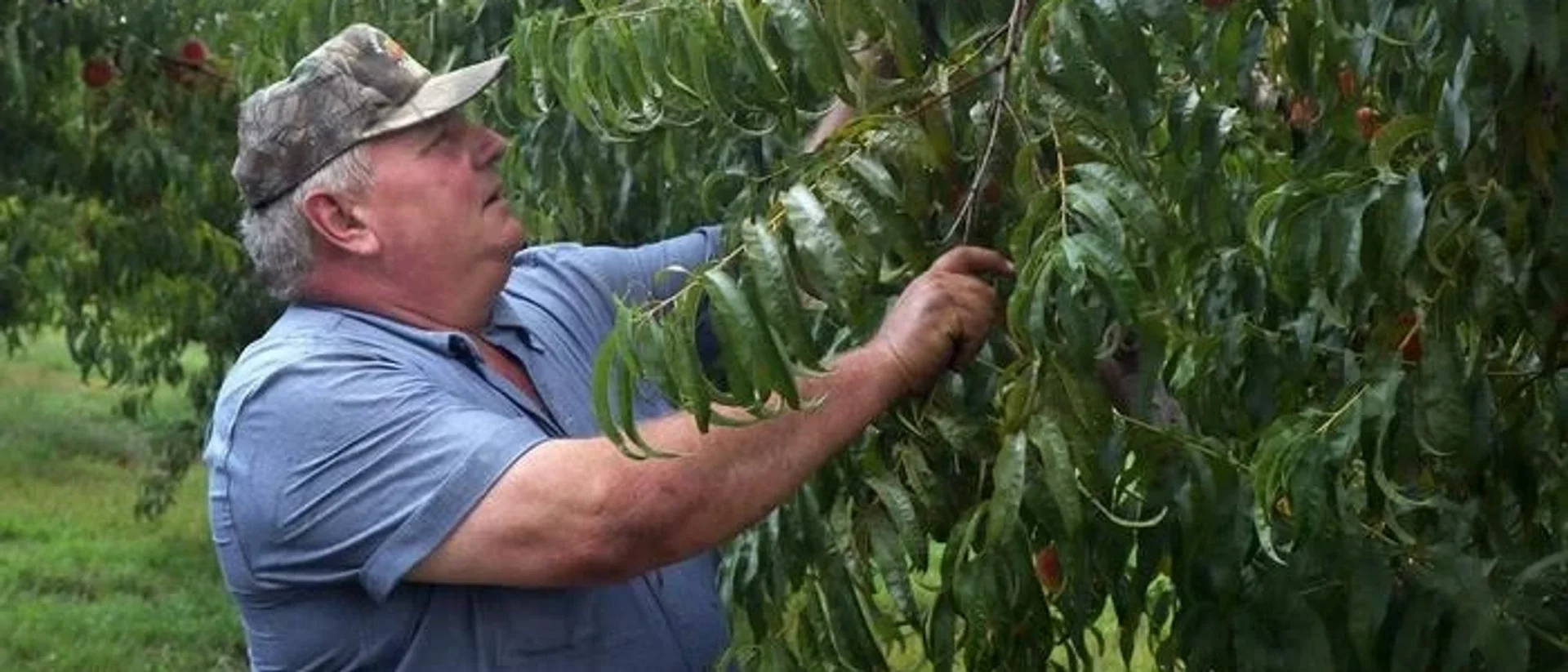
Bill Bader ran Missouri's largest peach farm until Monsanto's dicamba herbicide drifted in from neighboring fields and killed 30,000 of his trees. Discovery turned up 180 internal documents showing the company had projected exactly that kind of damage and sold the product anyway. A federal jury in the Eastern District of Missouri awarded Bader $265 million.
Bader Farms Won $265 Million From Monsanto After Dicamba Killed 30,000 Peach Trees
Bill Bader's family ran Bader Farms in Campbell, in southeastern Missouri. Roughly 1,000 acres, the largest peach operation in the state. Then the dicamba started drifting in.
The Drift
Dicamba is a herbicide sold by Monsanto (now Bayer) and BASF, designed to be paired with genetically modified dicamba-tolerant soybeans and cotton. The problem with dicamba is that it is volatile. It evaporates off treated fields and drifts onto neighboring land, killing crops that were not engineered to resist it.
Bader's peach trees were not dicamba-tolerant. When neighboring soybean farmers started spraying, the herbicide drifted onto his orchards and destroyed approximately 30,000 peach trees, effectively wiping out the operation.
The Documents
Bader Farms sued Monsanto and BASF in the U.S. District Court for the Eastern District of Missouri. During trial, the plaintiffs introduced more than 180 internal company documents. The records showed Monsanto had projected thousands of off-target drift complaints from farmers and rolled the product out anyway.
The Verdict
In February 2020, the federal jury found Monsanto/Bayer and BASF liable. The award was $15 million in compensatory damages and $250 million in punitive damages, totaling $265 million. It was one of the largest agricultural verdicts in American history.
The Appeal
The verdict did not survive intact. The trial judge first cut the punitive damages to $60 million. The 8th Circuit Court of Appeals then vacated even that reduced amount and ordered a new trial on punitive damages only. The $15 million in compensatory damages stands. The final punitive number remains unresolved.
What remains is a precedent: a family farmer with 30,000 dead trees and a stack of internal corporate emails took on one of the world's largest chemical companies in front of a federal jury, and won.
Frequently Asked Questions
What happened to Bader Farms?
What did the jury award Bader Farms?
Did the $265 million verdict survive appeal?
What did the internal Monsanto documents show?
Verified Fact
Verified via NPR (primary), Sierra Club, Investigate Midwest, Civil Eats. Confirmed: 30,000 peach trees destroyed; Feb 2020 jury verdict $265M ($15M compensatory + $250M punitive); BASF co-defendant alongside Monsanto/Bayer; 180+ internal documents; case in U.S. District Court for the Eastern District of Missouri; trial judge reduced punitive to $60M; 8th Circuit vacated punitive entirely and ordered new trial on punitive only; $15M compensatory stands; final punitive figure unresolved.
NPRRelated Topics
More from Lawsuits

AutoZone Manager Said "I Feel Sorry For You" to a Pregnant Employee. The Jury Came Back With $185 Million.
When Rosario Juarez told her AutoZone district manager she was pregnant, he replied "Congratulations... I guess," then added "I feel sorry for you." She was demoted, then fired…
The Hotel Had No Policy Against This
The Nashville Marriott at Vanderbilt confirmed Erin Andrews' room number to a caller and booked him into the adjacent room. Michael Barrett then used a hacksaw to modify her pe…

Air Canada told a court its chatbot was "a separate legal entity." The court disagreed.
Air Canada's lawyers told a tribunal that the airline's chatbot was a separate legal entity responsible for its own actions, after the bot invented a refund policy that does no…
Wabash National Knew the Fix Cost $313. They Said No.
Trailer manufacturer Wabash National knew a safer rear guard design existed for 30 years - it cost $313 per trailer to install. The company chose not to. In May 2019, Taron Tai…