
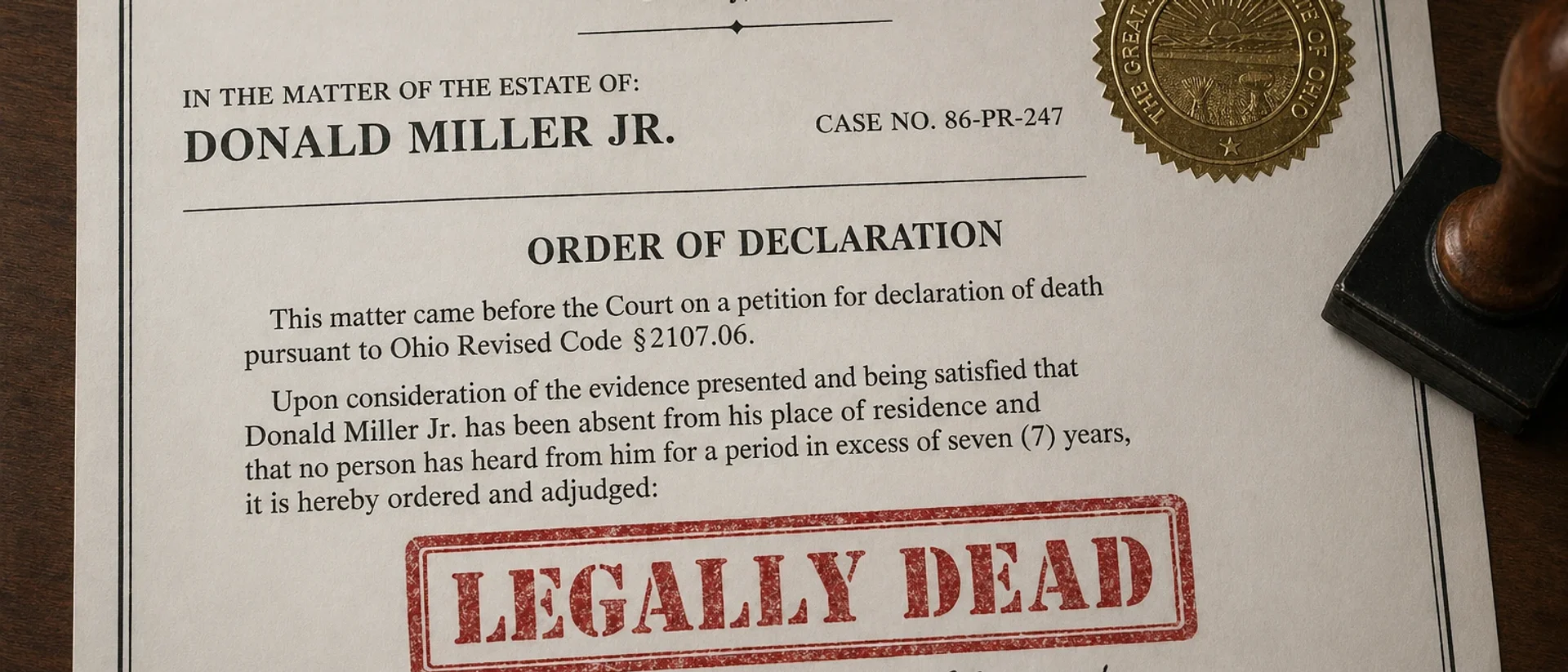
Donald Miller Jr. of Arcadia, Ohio vanished in 1986 and was declared legally dead in 1994 so his ex-wife could collect Social Security. In 2013, he walked into Hancock County Probate Court alive and asked to reverse it. Judge Allan Davis ruled the three-year window had expired. "I don't know where that leaves you, but you're still legally dead."
Hancock County Ruled Him Legally Dead. Then He Walked In Alive.
On October 7, 2013, a man who had been legally dead for nineteen years walked into the Hancock County Probate Court in Findlay, Ohio. His name was Donald Eugene Miller Jr. He was 61. He wanted his death certificate reversed.
How Miller Got Declared Dead
Miller vanished from Arcadia, Ohio in 1986, leaving his wife Robin and two daughters behind, along with a stack of unpaid child-support debt. Years passed with no contact. In 1994, Robin petitioned Hancock County to have him declared legally dead so the children could collect Social Security survivor benefits. The court granted it.
Miller, it turned out, was not dead. He had been living in Florida and Georgia, working odd jobs and drinking. He told the court he had walked away from a job loss and the debts that came with it.
What Judge Davis Said
Hancock County Probate Court Judge Allan Davis heard the petition and pointed at the Ohio Revised Code. Under state law, a death ruling can only be challenged within three years. Miller had missed that deadline by sixteen years.
From the bench, Davis delivered the line that travelled around the world:
"I don't know where that leaves you, but you're still legally dead."
Davis acknowledged the ruling was strange. He told the AP it was "a strange, strange situation" but said his hands were tied by the statute. The petition was denied.
The Consequences of Being Officially Dead
Miller could not get a driver's licence reinstated. He could not legally use his Social Security number. He could not file taxes in the normal way. Any attempt to function as a citizen ran into the same wall: the state of Ohio said he did not exist.
Robin opposed reversal for a separate reason. The Social Security Administration had paid out survivor benefits for the daughters, and undoing the death ruling could trigger a clawback. Davis noted the financial entanglement on the record.
What Happened After
Miller said in court he planned to appeal. He never successfully did. As of the most recent reporting, Donald Miller Jr. remains, by Ohio law, a deceased person walking around Ohio. The Hancock County order stands.
Frequently Asked Questions
Why was Donald Miller declared legally dead?
Why couldn't the judge reverse the death ruling?
What exactly did Judge Allan Davis say?
What happened to Donald Miller after the ruling?
Verified Fact
BBC News (24486718) confirms named subject (Donald Eugene Miller Jr.), named court (Hancock County Probate Court, Findlay, Ohio), named judge (Allan Davis), the 1986 disappearance, 1994 death declaration petitioned by ex-wife Robin for Social Security benefits, October 2013 hearing, the three-year Ohio statute of limitations on challenging a death ruling, and the verbatim quote. AP coverage of the same hearing corroborates Davis's "strange, strange situation" language and the financial-clawback concern raised by the ex-wife. Ohio Revised Code 2121 governs the three-year window. Miller's age (61) and the geographic detail (Arcadia / Findlay) cross-check across BBC, AP and NPR reports from October 2013. Trimmed: any specific detail about his exact whereabouts during the missing years beyond Florida/Georgia general reporting.
BBC NewsRelated Topics
More from Spectacle
The Mob Barrel Lake Mead Has Been Hiding Since the 1970s
When the 2022 drought dropped Lake Mead to its lowest level since filling in 1937, boaters at Hemenway Harbor found a corroded 55-gallon barrel containing human remains…

The Trump campaign's election press conference was at Four Seasons Total Landscaping - between a sex shop and a crematorium.
On November 7, 2020, Rudy Giuliani held a Trump campaign press conference at Four Seasons Total Landscaping in northeast Philadelphia, two doors from Fantasy Island Adult Books…